
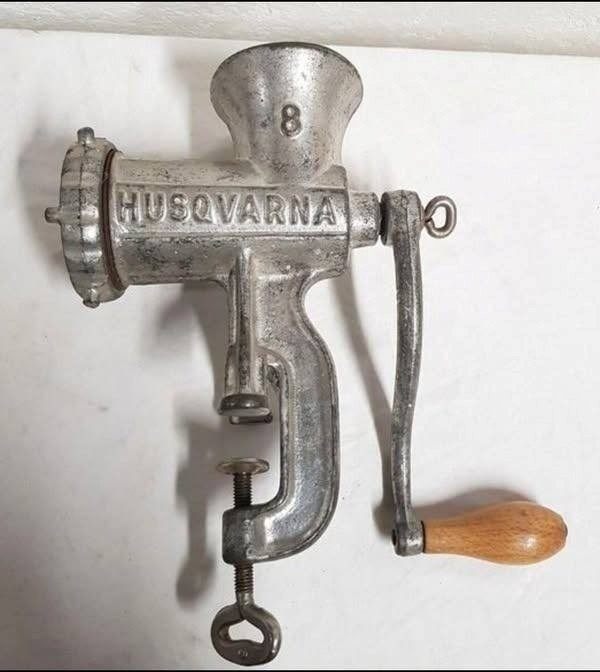
The Entire Internet Collaborated to Determine What This Tool Could Be — And Still Wasn’t Sure
It started the way these things always do.
A single photo.
A simple question.
No context.
Just an image of an object—metallic, oddly shaped, clearly something, but not immediately recognizable. No label. No brand name. No explanation. Just a caption along the lines of:
“Does anyone know what this tool is?”
And with that, the internet did what it does best.
It stopped everything else and got to work.
The Moment Curiosity Took Over
Within minutes, the image was everywhere.
Shared to forums.
Cross-posted to social media.
Dropped into group chats.
Screenshot and reposted with increasingly dramatic captions.
People who had no idea what they were looking at still felt compelled to stare.
Because the object sat squarely in the uncanny valley of tools:
- It looked useful
- It felt purposeful
- But it defied immediate recognition
And that combination is irresistible.
Why This One Image Captured So Much Attention
The internet sees thousands of objects every day. Most pass without a second glance. But this one had the perfect storm of qualities to ignite collective obsession.
It was:
- Clearly designed for a specific function
- Old enough to feel mysterious
- Familiar enough to feel solvable
- Strange enough to spark debate
This wasn’t abstract art or modern nonsense. This was a tool—something meant to do something.
Which meant someone, somewhere, had to know.
The First Wave of Confident Answers
As always, the early comments were confident. Bold. Certain.
People declared:
- “That’s obviously a woodworking tool.”
- “My grandfather had one of those.”
- “I’ve used this before — it’s for farming.”
- “Definitely something medical.”
- “No, no, it’s for leatherworking.”
Each comment sounded authoritative.
Each contradicted the last.
And yet, no one backed down.
The Rise of Wild Theories
Once the obvious guesses failed to gain consensus, creativity took over.
Suddenly the tool was:
- A medieval torture device
- A Victorian medical instrument
- A shoe-making clamp
- A hair-styling tool from the 1800s
- A weapon disguised as household equipment
Someone suggested it was used for corsetry.
Someone else insisted it was for horse dentistry.
Another swore it belonged in a textile mill.
At least one person suggested it was “definitely cursed.”
The comments stopped being about answers and started being about entertainment.
Experts Enter the Chat
Eventually, people with actual experience arrived.
Machinists.
Carpenters.
Antique collectors.
Farmers.
Engineers.
Museum volunteers.
Each brought:
- Diagrams
- Historical references
- Anecdotes
- Photos of similar-looking tools
And yet—still no agreement.
One expert would explain why it couldn’t be a certain tool.
Another would explain why it had to be.
The mystery deepened instead of resolving.
When the Internet Realized This Was a Group Project
At some point, the tone shifted.
This wasn’t just a comment section anymore.
This was collaboration.
People began:
- Zooming in on tiny details
- Noting wear patterns
- Measuring proportions
- Comparing materials
- Searching old catalogs and patents
Someone recreated it in 3D.
Someone else found a grainy black-and-white photo of something similar.
Another translated a foreign-language manual that might be related.
Strangers were working together like a distributed research team.
All for one object.
Why We Love Solving These Mysteries Together
This wasn’t about the tool anymore.
It was about:
- Shared curiosity
- Collective intelligence
- The joy of problem-solving
In a world where the internet often feels divided, moments like this remind us of something important:
People love figuring things out together.
No politics.
No arguments about reality.
Just a shared puzzle.
The Tool Became a Character
As the mystery dragged on, the object itself took on personality.
People started referring to it like an old friend:
- “Has anyone figured him out yet?”
- “The tool remains unbothered.”
- “The tool is judging us.”
Memes appeared.
Fan art appeared.
Someone wrote a fake backstory.
The tool was no longer just an object.
It was a symbol of internet chaos and cooperation.
False Resolutions and New Confusion
Eventually, someone would post:
“I figured it out.”
Hope surged.
Threads exploded with excitement.
But then:
- The explanation didn’t quite fit
- The measurements were off
- The function didn’t explain all features
Back to square one.
This happened repeatedly.
Each “solution” brought new questions.
The Psychology Behind the Obsession
Why did this matter so much?
Because the human brain hates unresolved patterns.
We are wired to:
- Seek meaning
- Recognize purpose
- Assign function
An object with no clear explanation creates mental friction.
The longer it remained unsolved, the stronger the urge to resolve it.
The Internet as a Collective Brain
This moment showcased something powerful:
No single person had the answer.
But everyone had part of it.
One person noticed wear marks.
Another recognized the metal.
Another understood leverage.
Another recalled a similar object from childhood.
Knowledge layered on knowledge.
The internet wasn’t just noisy—it was thinking.
When Context Finally Appeared
Eventually—sometimes days, sometimes weeks later—context emerged.
Maybe:
- The original poster found more information
- A manufacturer was identified
- An old manual surfaced
- A museum curator weighed in
Suddenly, the object had a name.
A function.
A history.
And the answer was often… underwhelming.
It was usually:
- A highly specific tool
- Used for a niche task
- From a time when specialized tools were common
Nothing dramatic.
Nothing cursed.
Nothing sinister.
Just practical.
The Collective Reaction to the Answer
When the truth finally surfaced, reactions were mixed.
Some people felt relief.
Some felt disappointed.
Some refused to accept it.
Comments read like:
- “That’s it? Really?”
- “I preferred the mystery.”
- “No way — I still think it’s something else.”
Because the journey had become more interesting than the destination.
Why These Moments Matter
This wasn’t wasted time.
It was:
- Curiosity in action
- Collective learning
- Shared wonder
In a small way, it reminded people what the internet can be:
- Curious instead of cynical
- Collaborative instead of combative
- Playful instead of exhausting
A Digital Campfire Story
These object mysteries function like modern folklore.
Someone brings a strange thing to the group.
Everyone gathers around.
Stories are told.
Theories are shared.
Knowledge is passed down.
It’s ancient behavior, just digitized.
The Tool Goes Quiet — But Not Forgotten
Eventually, attention moves on.
The comments slow.
The reposts stop.
The internet finds its next puzzle.
But the tool lives on:
- In screenshots
- In memes
- In inside jokes
- In the memory of collective curiosity
For a moment, it brought strangers together.
That matters.
Final Thoughts
The question “What is this tool?” turned into something much bigger.
It became:
- A reminder of shared intelligence
- A celebration of curiosity
- Proof that the internet can still collaborate for joy
We may not always agree.
We may not always be kind.
But give us a strange object and a mystery—
And we’ll come together every time.
And honestly?
That might be the most human tool of all.
